

Shin Splints is a common term for shin pain during running. It can be a misleading term and most sports medicine professionals try to avoid using it. This is because shin pain and 'Shin Splints' can be due to several different conditions. One of the most common shin conditions that is frequently labelled 'Shin Splints' is Medial Tibial Stress Syndrome.
Medial Tibial Stress Syndrome has been reported to occur frequently in military recruits, distance runners, dancers, football (soccer) players and gymnasts. Medial Tibial Stress Syndrome has been classified into two distinct types, which affect specific tissues on the inside of the shin:
Regardless of the type, Medial Tibial Stress Syndrome is largely caused by over-use, with those who run regularly on hard or uneven surfaces being particularly affected. However, there are a number of factors, such as altered foot, knee and hip posture, which can make a person susceptible to the syndrome.
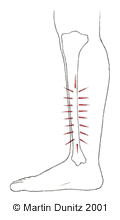
People suffering from Medial Tibial Stress Syndrome will feel pain on the inner border of the shin (medial Tibial border) during and following exercise. It is important to distinguish Medial Tibial Stress Syndrome from other causes of shin pain ('shin splints') such as Compartment Syndrome or a Tibial Stress Fracture. This can require a complex run through of investigations, such as bone scans and compartment pressure tests under the supervision of a sports physician or orthopaedic doctor.
For the immediate treatment of symptoms Ice Therapy is a very effective form of pain relief (never apply ice directly to the skin). The PRICE protocol - protection, rest, ice, compression and elevation can relieve the symptoms of a painful shin. Ice Packs for a period of twenty minutes every couple of hours may help with the pain, but pain-relieving medication and Anti-Inflammatory Gel may also be necessary.
Most patients respond well to non-operative treatment. This involves rest, strengthening and stretching exercises, followed by a gradual return to running after symptoms subside. In order to help prevent recurrence of the condition, a bio-mechanical analysis (an analysis of posture at rest and during walking and running) with a physiotherapist or podiatrist can be very useful. This will pick up any factors that may be making a person susceptible to Medial Tibial Stress Syndrome, so that they can be corrected before a return to activity.
Muscle imbalance and leg length inequality are frequent causes of mal-alignment that can be picked up during the physiotherapy assessment. A common cause of Medial Tibial Stress Syndrome is pes planus (flat feet) or pronated foot position (a lowered arch during running). These would be identified during bio-mechanical analysis. Over pronation is the uncontrolled lowering of the arch of the foot during running. This puts increased strain on the Tibialis Posterior muscle which pulls on the inside of the shin and can produce pain. Arch supporting Orthotics insoles can be very effective in remedying this problem.
All cases of pain in the shin should be properly assessed by a chartered physiotherapist or an orthopaedic consultant as shin conditions can be made worse by continuing with exercise. The best way of maintaining fitness during this time is to use non weight bearing exercises in the swimming pool. Running without touching the bottom of the pool while wearing a Buoyancy Belt is a great method of maintaining fitness while allowing the injury to heal.
In cases of shin pain that have been investigated by a doctor and found to be a soft tissue problem, many people find that a Compression Sleeve can be an effective treatment that allows them to run. Compression sleeves work by restricting the pull of muscles in the shin, which can reduce the stresses on the shin during running. Without being a cure for Shin Splints, they can effectively reduce symptoms, allowing runners to get round.
In some persistent cases of Medial Tibial Stress Syndrome that are resistant to conservative treatment, surgery may be necessary.
| |
Maintain a running log to track progression |
| |
Reduce shin stress with shock absorbing insoles |
| |
Use the Aircast AirLift to correct flat feet & fallen arches |
As with all over-use injuries, Medial Tibial Stress Syndrome is caused by doing too much, too soon. When beginning or changing an exercise programme, any increases in activity must be gradual. For example, an increase from running 2 miles per day one week to running 10 miles per day the next week cannot be undertaken without putting the body at risk of a number of problems. Maintaining a Running Log can resolve this problem.
The amount of stress being placed on the shins can be minimised by wearing good quality, supportive running shoes with Shock Absorbing Insoles. Medial Tibial Stress Syndrome can be prevented by correcting problems such as flat feet and fallen arches. The Aircast AirLift is a support that uses aircells to lift the arch of the foot, which relieves pressure on the arch and the Tibialis Posterior Tendon. The Aircast AirLift can be used as part of a conservative treatment if fallen arches are thought to be contributing to the shin pain.
NEW!Compression socks that improve circulation and can speed recovery following sporting activity. ...
Specialist neoprene calf support with Velcro fastener to provide enhanced compression and support for the Calf region. ...
BEST SELLER! The professionals' choice for the treatment of shin splints. An elasticated shin and calf sleeve...
BUY 2 SAVE 15%!Pull on neoprene sleeve to provide support and compression to the Calf and Shin region. Ideal for...
Superb support for the treatment of fallen arches and flat feet related to Posterior Tibial Tendon Dysfunction (PTTD)....
Durable 4mm shock absorbing heel pads, with excellent 36 month life expectancy. Designed to wear under existing insole. ...
NEW!3/4 length arch supporting, anti pronation orthotics for narrow toed footwear. With deep heel...
NEW!Fabric lined gel cushion heel pads with, to relieve heel pain during running and walking....
Shock absorbing heel pads that provide extra cushioning, shock absorption and lift to the heel region. Simply fit them on top of...
SPECIAL OFFER Shock absorbing insoles that provide extra cushioning for the heel and forefoot, to prevent and...
BEST SELLER!Orthotic insoles that provide increased stability and support for the arch of the foot. ...
3/4 length insoles with soft cushions for the arch of the foot, suitable for 'hard to fit' shoes. ...
NEW!A pair of 3/4 length Impact Gel insoles, to relieve foot pain in people who are on their feet all...
BEST SELLER!A 'cutting edge' shock dissipating material with a unique carbon fibre arch re-enforcement....
Replacement insole with a special cushioning zone in the heel, making them most suitable for walking, running & jogging. ...
NEW!A pair of thin (6mm) silicone gel heel cushions, with extra soft blue dot to relieve heel pain....
BEST SELLER!Ultra soft, high quality heel cups - provide the ultimate in shock absorption and also stabilise...
Essential ice and compression kit to relieve pain. Designed to reduce swelling and speed up recovery following a sports injury,...
12cm x 15cm fabric wrap with adjustable flaps, used to secure two supplied ice / heat packs in place. ...
Deep Relief dual action gel with ibuprofen is a clear, non-sticky and non-greasy gel with a mild, pleasant menthol fragrance. ...
Easy to use dual channel digital TENS machine for effective pain relief featuring seven preset programmes. Just stick on the...
Flip design dual channel digital TENS machine for unbeatable pain relief. Features a wider range of variations than other TENS...
Superb value, 8 x 1m length resistance bands in all 4 varying strengths, for use during rehab exercises for the shoulder, ankle,...
65cm (26") diameter Swiss Ball for people 165-185cm (5'6" - 6'0") tall. Includes FREE exercise chart. ...
A floatation belt that allows an early return to activity in the swimming pool. Early non weight bearing cardiovascular...
Non-dated, 52 week running log with helpful information for runners, for optimising the effectiveness of any training plan It is...
Receive our latest news and offers.
Information
& Expertise
You Can Trust
All medical information at PhysioRoom.com is provided by Chartered Physiotherapists, who specialise in sports medicine.
We use full 128-bit encryption technology to keep your order and payment details safe.
